
War of 1914 - on the front lines
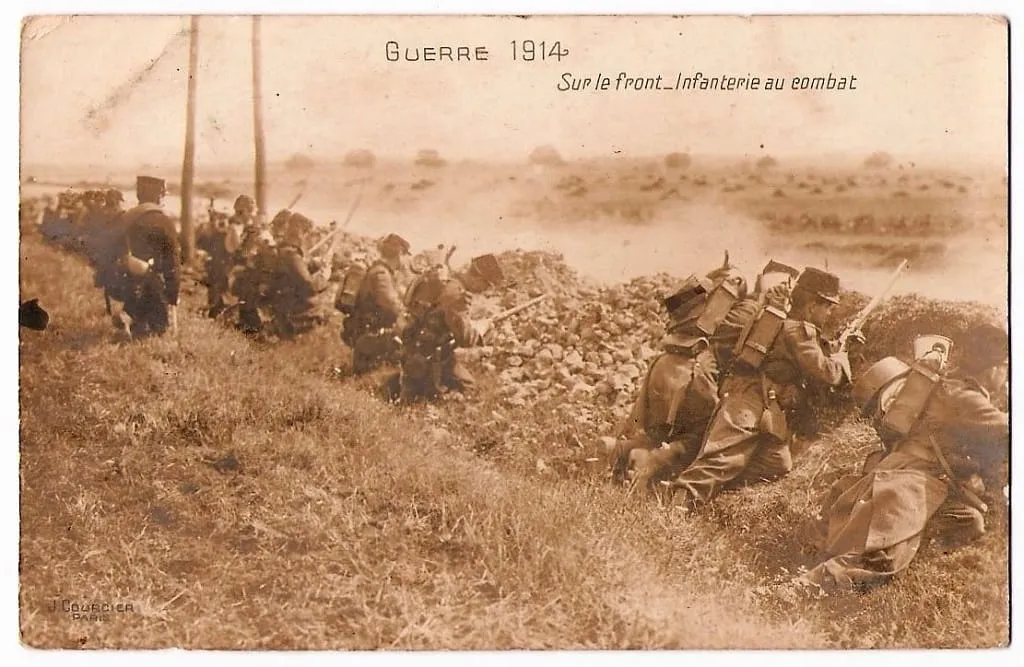
There's a lot to unpack with this card.
It’s the first in a long series of postcards from World War I.
First, it’s interesting that it says "War 1914." This was at the very beginning of the war. Obviously, people had no idea how long it would last. In 1914, everyone thought it would be short. This is probably the case for every war.
The trenches weren't a thing yet. The French infantry was still wearing its original uniform of red pants and hats, which had been the norm since the 19th century.
As has been well-documented, these uniforms were partly responsible for the heavy losses of the French army at the beginning of the war. A hat with red parts is the perfect target for a head shot.
Ironically, there had been a push a few years before the war to remove the red from the uniforms, but enough conservative politicians and high-ranked officers opposed it. Although warfare had begun to mechanize, no one could have imagined what World War I would be like. The "horizon blue" uniforms had already been designed by the time the war broke out, but they could not be mass-produced in large enough quantities before 1915, when they finally replaced the blue and red uniforms. By then, the bloodbath had already occurred.
The text on the back of the postcard is equally captivating and informative:
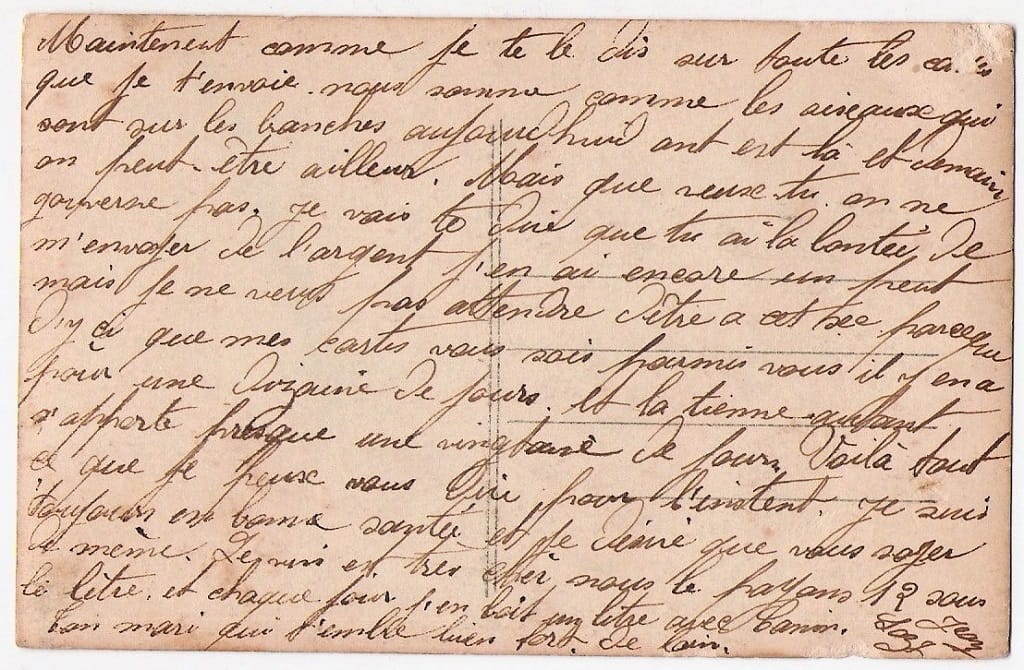
First, some background information.
This is one of the many cards that Jean Sazy wrote to his wife, Jeanne, while he was a conscript on the front lines.
I’m not sure exactly who he was (my mom thinks he was a cousin of my grandfather), and I have no idea how these cards ended up in the postcard collection I inherited.
Interestingly, I also have some cards that Jeanne wrote to her husband.
My dad vaguely remembers someone named Jean living with his family for a short time when he was a child.
I tried to find information about him online. France has an official website that lists all those who died while enlisted in the military. There are two Jean Sazy, but neither matches. There is actually a "Jean-Baptiste Sazy" from the same area, but he died in 1914. "Our" Jean continued writing throughout the war.
Also, Sazy is a fairly common last name in my home region and Jean was one of the most common first names in France back then. Obviously, not much information about him made it to the digital era (genealogy is sometimes helpful, but I had no luck on that front either).
A few years ago, the INSEE digitized data on people who died in France after 1970. I found two "Jean Sazy" who could be him. One in particular was born (in 1892) and died (in 1974) in Donzac, a small village very close to my dad's home village and that Jean mentions in another postcard.
There is no information about Jeanne, but she would probably be listed under her maiden name.
Jean's cards are sometimes difficult to read. He often tried to fit as much as possible onto one card. His texts also often spanned several cards. It's an interesting reminder that space was an important constraint of the writing medium back in the day. Even more so when you’re on the front lines, I would imagine.
It's actually one of the main topics of this text, though the middle part is sometimes difficult to understand. His handwriting is not always easy to decipher. Plus, he’s not above making grammatical mistakes. Finally, he sometimes uses old expressions that have different meanings today.
Please note that this is the final part of a longer letter. Unfortunately, I couldn't find the beginning (it's harder to sort those when you only have them in digital form). Hopefully, it will show up at a later date.
Here is a rough translation:
Now, as I tell you on every card I send you, we are like birds on branches. Today, we are here, but tomorrow, we may be somewhere else. But you know, we’re not the ones in charge.
I’ll tell you what, have the goodness to send me some money. I still have some, but I don’t want to wait until I run out, because only my cards that are provided to us (?) I have enough for about ten days. And yours (?) will last a fortnight.
That’s all I can tell you for now.
I am still in good health and I hope you all are healthy too.
Wine is very expensive, we pay 12 cents per liter, and every day we drink a liter with Lanois (?)
Jean Sazy
Your husband, who sends you a big kiss from afar.
As I publish more of his cards, you’ll see that he never really says anything of substance. Soldiers weren’t allowed to share much, and correspondence with the outside world was heavily censored. However, I think his cards are invaluable for teaching us about the daily lives of soldiers, their moods, and more. His state of mind changed greatly as his time in the army increased from weeks to months to years, given all the deaths and horrors he witnessed.
Stay tuned for more.
Thanks for reading.

Comments ()