
Bastille – July Column – circa 1916
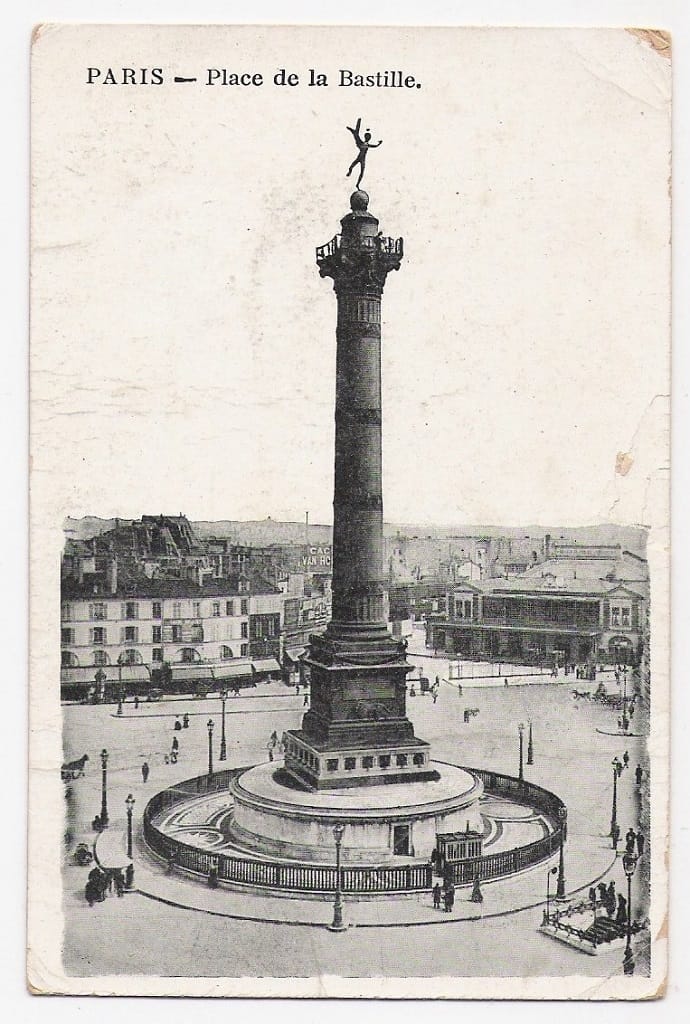
This is the Place de la Bastille in Paris, about 100 years ago.
And this is what it looked like 90 years later:
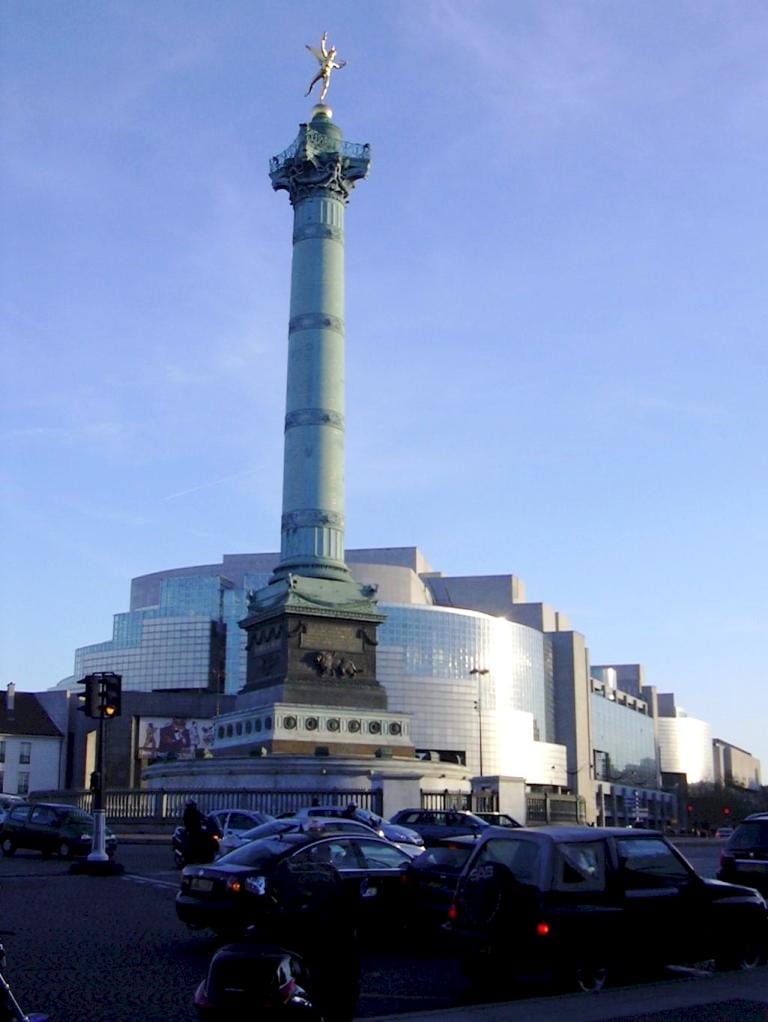
The postcard shows the building that stood before the Opera Bastille was constructed. The July Column, on the other hand, hasn’t changed much since its construction in 1840. Interestingly, the remains of the building on the left side of the postcard, though smaller, haven’t changed much either.
I’ll tell you more about the history of Place de la Bastille at a later date. Today, I’d rather focus on the other side of the postcard.
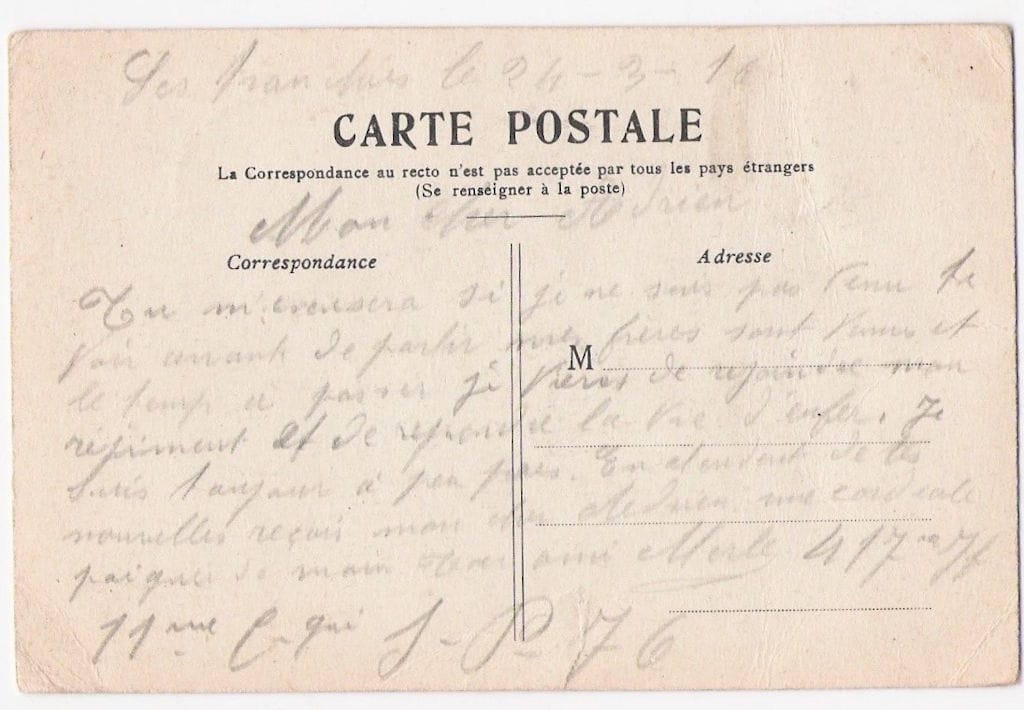
It was sent to my grandfather (Adrien) by a man called Merle. Here is what it says:
The trenches (1), March 24th, 1916.
My dear Adrien,
Sorry for not visiting you before leaving. My brothers came and time passed.
I have just rejoined my regiment and I am back to this hellish life. I am still so-so (2). Hoping to hear from you soon, receive my dear Adrien a cordial handshake. (3)
Your friend, Merle
417th Infantry, 11th Company, S-P 76 (4)
(1) I had trouble reading the name, and for a while, I thought it was the name of a village. However, one reader, Olivier, reminded me that soldiers were usually not allowed to reveal their location in their correspondence. Merle just wrote "the trenches" instead.
Merle belonged to the 417th Infantry Regiment, however, and I was able to find its history. If you can read French, you can find it there. In March 1916, the regiment was stationed in Vingré, in the Aisne department.
(2) I'm not too sure I understand what he's saying here in the original text. It's probably an expression that has fallen out of use. I assume he means he's not feeling so great. He's holding on, or something like that. We can imagine the mood of the soldiers after two years of this terrible war when they had to return to the front after leave.
(3) I like the "cordial handshake." It feels old-fashioned, but in a good way.
(4) I was told that S-P 76 probably means "Secteur Postal 76." Basically his address, as he can't give a real one.
I tried to find out more about Merle. I don't think I have many cards written by him. Maybe one or two more. Maybe? I can’t remember at the moment, nor can I dig through them. His name isn't mentioned in the regiment's history mentioned above.
France has an official online archive of all soldiers who died for the country. It's not the most uplifting thing, but it's very useful for finding information about World War One.
Searching for the Merles born near my grandfather’s village who were around his age and still alive in March 1916, I found a Jean Urbain Merle. He was born in 1881 in Lamagistère, so he was four years older than my grandfather and born just a couple of kilometers away. He could be him.
His inclusion in this archive is interesting because he did not die in combat or during the war. He died of illness in Nérac in 1919. The fact that his death record from the ministry mentions it makes me think that he was in a military hospital. It wouldn't surprise me if this "illness" was actually the Spanish flu. Interestingly, perhaps because it occurred so close to World War I, we rarely hear about people who died from the flu. It's only ever discussed in vague, general terms. I wonder why.
There’s one problem, though: Jean Urbain Merle is listed as a member of the 11th Infantry Regiment, not the 417th. However, when you delve into the history of the 417th, you learn that it was disbanded in 1917. Merle could have been reassigned to another regiment. An internet search tells me that the battalions were transferred to the 167th and 168th regiments. Did this affect all the soldiers? I have no idea.
So, there is no certainty whether my grandfather’s friend is Jean Urbain Merle or not.
We’ll see later if I find other cards signed by him, and whether they contain more information.
Stay tuned….
Comments ()