
The Speed of Time
Why do we perceive time differently as we age and why does it seem to go faster and faster?
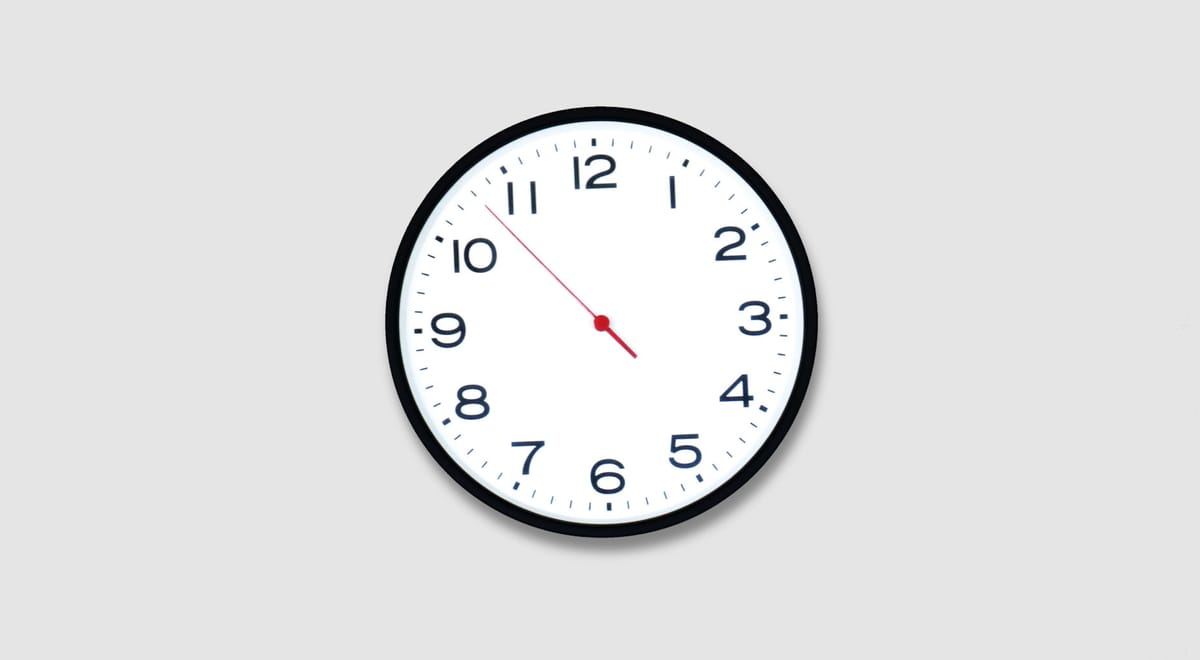
If you're over a certain age, you've probably noticed that time seems to be passing faster and faster.
I was born in 1973, and while I don't remember much of the 70s, I can tell you that they went on for quite a long time, even though I was only alive for seven of those years, and I have only a handful of memories of the first three or four. The 80s also seemed to go on forever; years and years in school, sitting at those old wooden desks, listening to dozens of teachers. The 90s were wild, and lasted long enough for all the things I did back then. The 2000s were full of major life changes, but they went by relatively quickly, when you think about it. Same with the 2010s, it seems like just a few years ago my daughter was a baby, and now she's a teenager. And the 2020s? What? It's 2026 already? But 2020 was just two years ago, right?
You know the feeling.
Why is that?
You've probably asked yourself this question before, and you may even know the answer.
No, the astrophysical side of the topic has nothing to do with it. At least, I hope it doesn't. On the contrary, shouldn't time slow down as the universe cools down? I have no idea. Even if it does, I'm pretty sure that we can't perceive it over the course of a human lifetime.
Yes, there are some neurological reasons for this. The more our brains learn new things, the slower time feels. The younger we are, the more we learn and record new memories and experiences, so the younger years feel longer.
However, there is another factor that I really like, and I think we can almost perceive it when we stop for a minute and really think about it:
The way we perceive time is highly subjective. All in all, we always perceive our life as a unit of time. I'm 52 years old as I write this, and to me, 52 years is 100% of my life. Meanwhile, my daughter's 13 years of life so far are 100% of her life up to this point.
Therefore, one year is 1.92% of the unit of time called "my life," while the same year is 7.69% of the unit of time called "my daughter's life." Therefore, 2024 lasted about four times longer for my daughter than for me.
And it's been theorized that this is the fundamental reason why years feel shorter as we age.
This perception affects our memories, so if a year seemed to last forever when we were kids, it will seem that way in our memories of that year too, regardless of how much we remember about it. Basically, when we look at the chronology of our lives, childhood always seems to last much longer than it did, and our teens and twenties seem quite long too.
Let's pretend I'm 50 years old (not to make myself seem younger, but to simplify the math), and ignore that I don't remember the first few years of my life.
My life can be divided into something like this, with each decade being a slice of the pie.
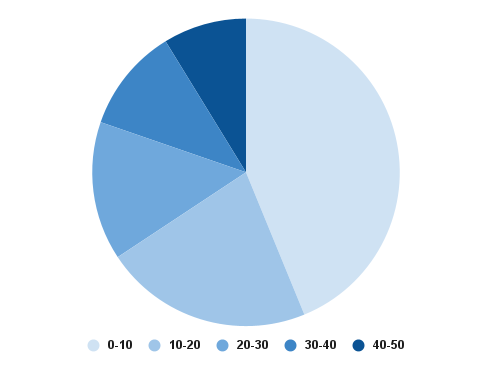
Note that this is an approximation. I decided that each year of the first decade would feel like 10% of my life during that decade (which is only true at age 10). Then, each year of the second decade would feel like 5% of my life (which is only true at age 20), and so on. Of course, I'm not taking into account the fact that I don't remember my early years and that most people don't begin to grasp the concept of time until around age five.
If you want a more mathematically accurate chart, I have this one, where year one is 100%, year two is 50%, year three is 33.33%, and so on.
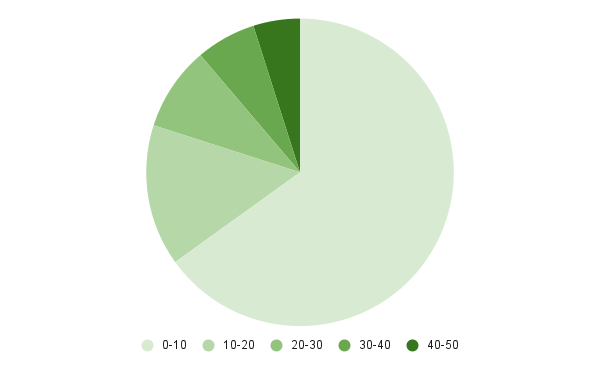
However, I don't like it that much because it places too much importance on the first ten years, especially the first three years, which we don't remember.
If we remove those first three years, the results are not significantly different from the first chart (the blue one).
I don't know if my childhood feels like about 40% of my life in my memory, but the other decades feel about right (with a caveat I'll explain below). Each decade is shorter than the previous one, but the difference between them gets smaller and smaller.
What do you think?
Caveat: Of course, the aforementioned neurological explanation is not to be dismissed. In fact, my twenties were much more eventful than my childhood or teenage years, and in my personal chronology, I feel that the '90s lasted a little longer than the '80s.
Before we wrap up, I'd like to address the first three years of life, which I dismissed so casually earlier. Babies and toddlers don't have a conscious concept of time, but surely they sense it, right? If you've ever been around an infant, then you know how impatient they can be. Time must certainly feel very slow to them.
What about babies? And newborns? Does time feel almost infinite to them? Or is their brain not developed enough to perceive it?
I wonder if scientists know the answers or have any theories. I assume they do (and I assume babies don't really perceive time at all). I want to look for them, but I'm afraid it's a rabbit hole that could suck me in for hours.
And you, what do you think? What has been your perception of time as you've grown older? Is it similar to mine or not?


Comments ()