
Why are the days of the week similar in many unrelated languages?
Something extremely surprising when one becomes familiar with Japanese culture and its language is that the names of days of the week are oddly similar to some European languages. Here is why.
Hello, everyone!
As you might have guessed from the title, today I want to talk about the days of the week and the similarities they have across several languages, including some that are completely unrelated. For obvious reasons, I'll focus on the days of the week in Japanese and in French (and, by extension, in other Romance languages), as well as in English.
A while ago, I noticed something pretty amazing.
I’m sure many serious researchers have studied this topic extensively, but I'm not one of them. I'll just share what I've noticed and a few explanations I know. Please excuse the lack of documented sources in this post in advance: I'll post a link to Wikipedia at the end of the article.
First, let's review the names of the days if you don't speak Japanese or French. This applies to all Romance languages because it's really about Latin. However, since French is my native language, I’ll focus on it instead of constantly saying, "as well as other Romance languages." Just assume it's there.
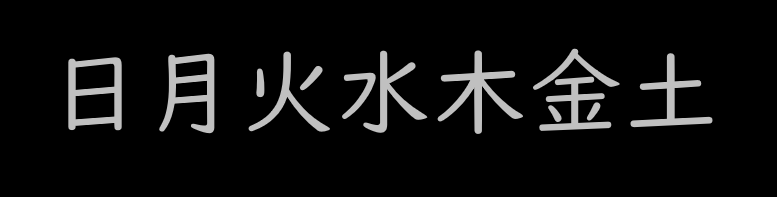
In Japanese, each day of the week consists of three kanji characters, but the last two are the same for every day and roughly mean "day of." For clarity and simplicity, I won't include them in the table below. They're often omitted in timetables and similar documents in Japanese, too.
For example, Monday is 月曜日, so we'll only write: 月.

Next to the kanji, you'll find the meaning in parentheses, though you may have already figured that out. If you’re familiar with Taoism, you may have noticed that Tuesday through Saturday are associated with the five traditional elements: fire, water, wood, metal, and earth.
You might be wondering why I'm alluding to Taoism, considering that it didn't spread to Japan. It didn't, however Taoism is an important part of Chinese philosophy, and China greatly influenced Japan about 1,300 years ago. This influence included introducing writing (kanji means "Chinese characters"), the days of the week, and many other things to Japan. However, since I’m more familiar with Japanese culture, I’ll focus on it in order to avoid saying anything silly. I could be wrong—I know almost nothing about Chinese languages—but I believe the days of the week we're talking about here aren't used in China anymore. (please correct me or add your insight in the comments if I'm wrong)
You may think that all of this is very nice, but what is my point?