
The Witching Hour
A review of "The Witching Hour," a graphic novel by Jeph Loeb and Chris Bachalo.
Whenever I return home to France, I rummage through my collection of old books, especially those I bought when I lived in the U.S. at the turn of the century. I often bring some of them back with me to Japan. It’s crazy when you think about how much these books have traveled, but it’s probably nothing compared to some of the CDs I own. I’m not even including the traveling they did before I bought them.
Among the books I brought back is a short graphic novel that I would have almost forgotten existed if not for some quotes from it that I still regularly use, especially: “I’ll try anything twice on the off-chance that I may have screwed it up the first time.” It’s one of the very first lines of the story (Note that I don’t actually live by it; I just like the quote.)
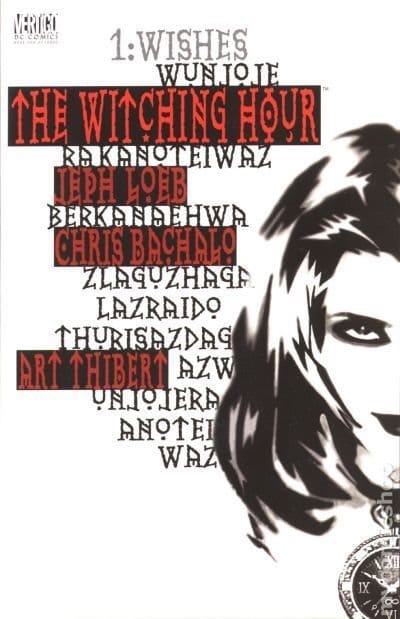
This book is called
The Witching Hour
It was written by Jeph Loeb with art by Chris Bachalo (with inks by Art Thibert). It was published by Vertigo in 1999-2000.
Despite the popularity of its authors, it seems that it was never a big success and remained somewhat obscure.
While it’s a complete story, I must admit that it feels somewhat incomplete, particularly in terms of character development. After reading it, you can’t help but feel like it’s a “pilot episode” of a series that never was. That’s probably what happened. Perhaps it would have become an ongoing series if the first story had been more successful, but it was not meant to be. This is just an assumption on my part.
I’m sure you know what it is about, right?
As the title suggests, it’s a story about a group of witches. Most of the story takes place in New York (and a little bit in Nevada too) in the present day, with a few flashbacks that take us back centuries.
The members of the coven are usually referred to by their color-coded names: White, Gray, Black, Blue, and Red. The story mostly focuses on White and, to a lesser extent, Gray, who often acts as the narrator. The others play a more minor role. The latter being the main reason why I feel more stories focusing on each of them were planned for the future but never came to fruition. Maybe.
Although both authors come from the superhero industry, this isn’t really a superhero story. Yet, it sometimes uses elements and tropes from the genre.
The witches aren’t villains, but they aren’t heroes either.
Still, they tend to help people who deserve it, mostly by granting their wishes. However, one of the morals of the story could be: “Be careful what you wish for.”
The witches also punish people who deserve it.
In terms of atmosphere, the story sometimes feels as if it could come straight out of a Neil Gaiman book. It really has a similar vibe, and the fact that Chris Bachalo drew some Sandman episodes added to that feeling for me. I forget if he illustrated anything from the main series, but he illustrated the Death mini-series, which was oddly enough my introduction to Sandman.
The Art
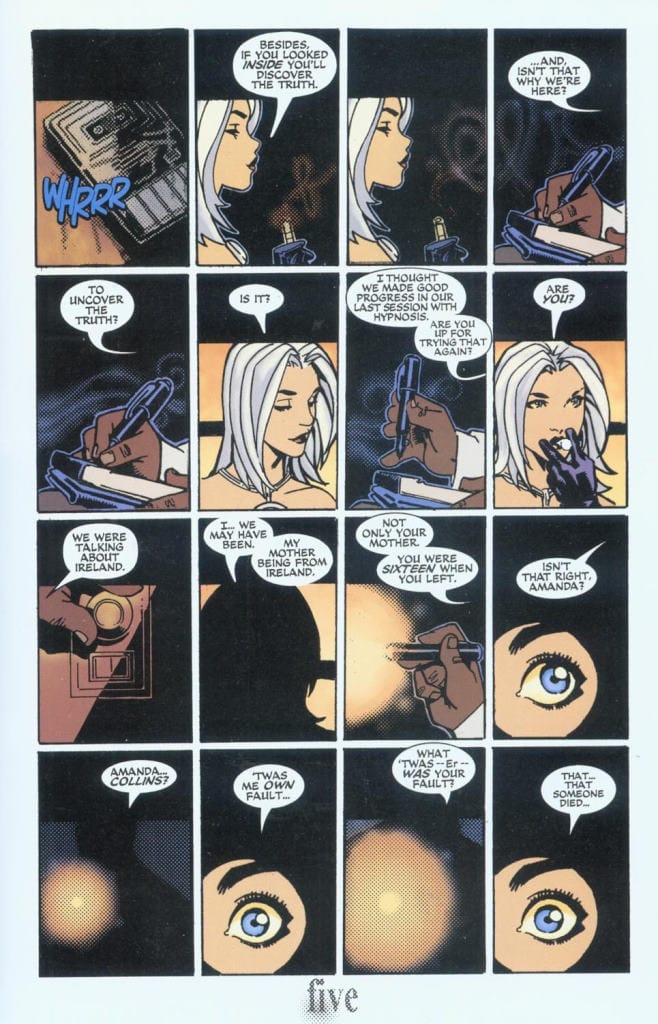
I’d say the art is some of the best Chris Bachalo has ever done.
I remember buying the comic solely because I saw his name on the cover and flipped through a few pages.
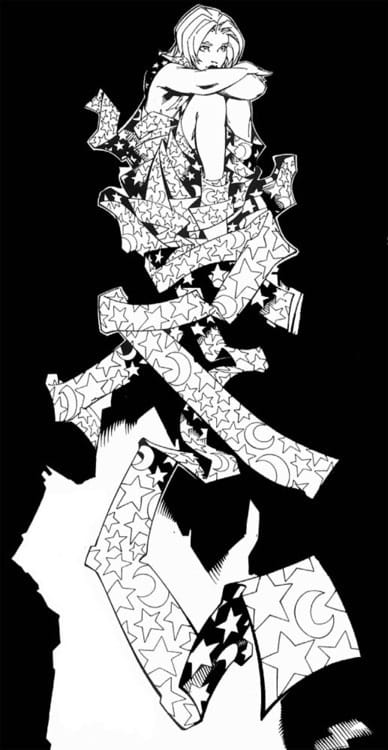
Bachalo’s art in The Witching Hour is sometimes dark and confusing, and appears messy, but each page is structured to serve the story, and nothing is uncontrolled. Some pages are so beautiful that they could be exhibited in a gallery without feeling like part of a larger work. But maybe I’m biased—I’ve been a fan of Bachalo’s since the early ’90s.
The Story
I have to be honest: it’s quite complex and hard to follow at times. The story itself isn’t that complex; the narration is. You follow several plots at once, and the structure and chronology are quite fragmented.
Everything makes sense in the end, and each plot point has a proper conclusion. However, you have to be prepared to be confused along the way. It’s not perfect. Sometimes I feel like Jeph Loeb tried to bite off more than he could chew (I can relate to that with my fiction writing) but it’s worth reading if you enjoy stories that aren’t spoon-fed to you.
My advice would be to read the whole story in one sitting, if possible, or read it a second time shortly after finishing.
That’s why I think it’s good, but maybe not a masterpiece. If it were a masterpiece, you wouldn’t need a second reading for everything to make sense.
Overall, though, with that caveat in mind, it’s really worth reading and it’s a shame it wasn’t more popular when it came out in the late ’90s.
Fun fact: When I started writing this post, I doubted that the book was still in print. But, surprise! A new edition was released in late 2024.
Comments ()