
Is Social Media Rotten to the Core? (part one)
Ten to fifteen years ago, social media reigned supreme on the internet and was the place to be. For better or worse, those days are long gone. Social media has become increasingly toxic. Elon Musk has dropped his mask and revealed himself to be the fascist piece of shit he has always been (pardon my French), and he bought Twitter to spread his nasty, destructive agenda. Mark Zuckerberg can no longer hide his sociopathic creepiness, and he'll stop at nothing to make his products addictive, allowing him to become richer and more powerful, regardless of the consequences for his users and society as a whole. Short vertical videos are destroying the attention spans of young (and not-so-young) people, too. Wen they're not destroying their literacy. It also makes them forget that our brains and eyes evolved to see horizontally, not vertically. But that part is a topic for another day.
I could go on, but you get the picture. The social media landscape is gloomier than ever, and I mostly see people divided into two groups:
- Those who don't care or have given up, they keep using social media as before, regardless of its impact on themselves and society.
- Those who can't stand social media anymore and have rejected it altogether.
What if I told you there is a third way?
Contrary to what some people think, social media is not inherently toxic or rotten. The current untenable state of affairs does not come from the nature of social media itself, but rather from the greed of the companies that popularized it. These companies would stop at nothing to increase their profits, even at the expense of their users and society as a whole. Once you accept that most "tech bros" are sociopaths, the big picture becomes easier to understand.
However, it doesn't have to be this way. Today, I want to introduce two social media platforms, or rather two groups of platforms, that are often called the open web.
Despite (or perhaps because of) their limited scale, I believe they represent the future of the social internet.
The Fediverse
You may or may not be familiar with the term Fediverse (I might have mentioned it before), but you've probably heard of Mastodon.
In very short, the Fediverse is an ensemble of social platforms that are both decentralized and federated.
What does it mean?
- Decentralized means that the Fediverse and most of its platforms belong to no one. Almost all of the Fediverse's platforms are open source, meaning anyone can use them as they see fit, anyone can modify the code and create their own version. Additionally, most platforms are not just one website or app, but rather a number of them. All of these websites and apps are independent from each other and controlled by different people.
If you're not technically inclined, the important part is that no one can buy or control the Fediverse or any of its platforms. - Federated means that all these platforms are linked and can communicate with each other as if they were the same platform. This means that any Mastodon server, or "instance," can communicate with any other Mastodon server. It also means that any Mastodon server can communicate with any server running a different platform (Pixelfed, Sharkey, Bonfire and more).
I won't go into the details here; I want to keep things simple. Understand that all Fediverse platforms are interoperable. Imagine if Facebook, Twitter, and YouTube were able to communicate with each other.
To give you a concrete example, I have a Mastodon account where I'm the only user. I pay 10€ every month to have it managed. Through it, however, I can follow, be followed, and communicate with users on any other Fediverse server.
If you have the technical skills, you can even manage your own server.
If you don't have the technical skills and don't want to pay money, you can join any of the tens of thousands of other public servers. The smallest ones (like mine) have one single user; the largest, Mastodon.Social has close to 300,000 monthly users.
If that can help you understand a little better, I warmly advise you to watch this great video made by filmmaker Elena Rossini, who has recently become an amazing promoter of the Fediverse for non-tech oriented people.

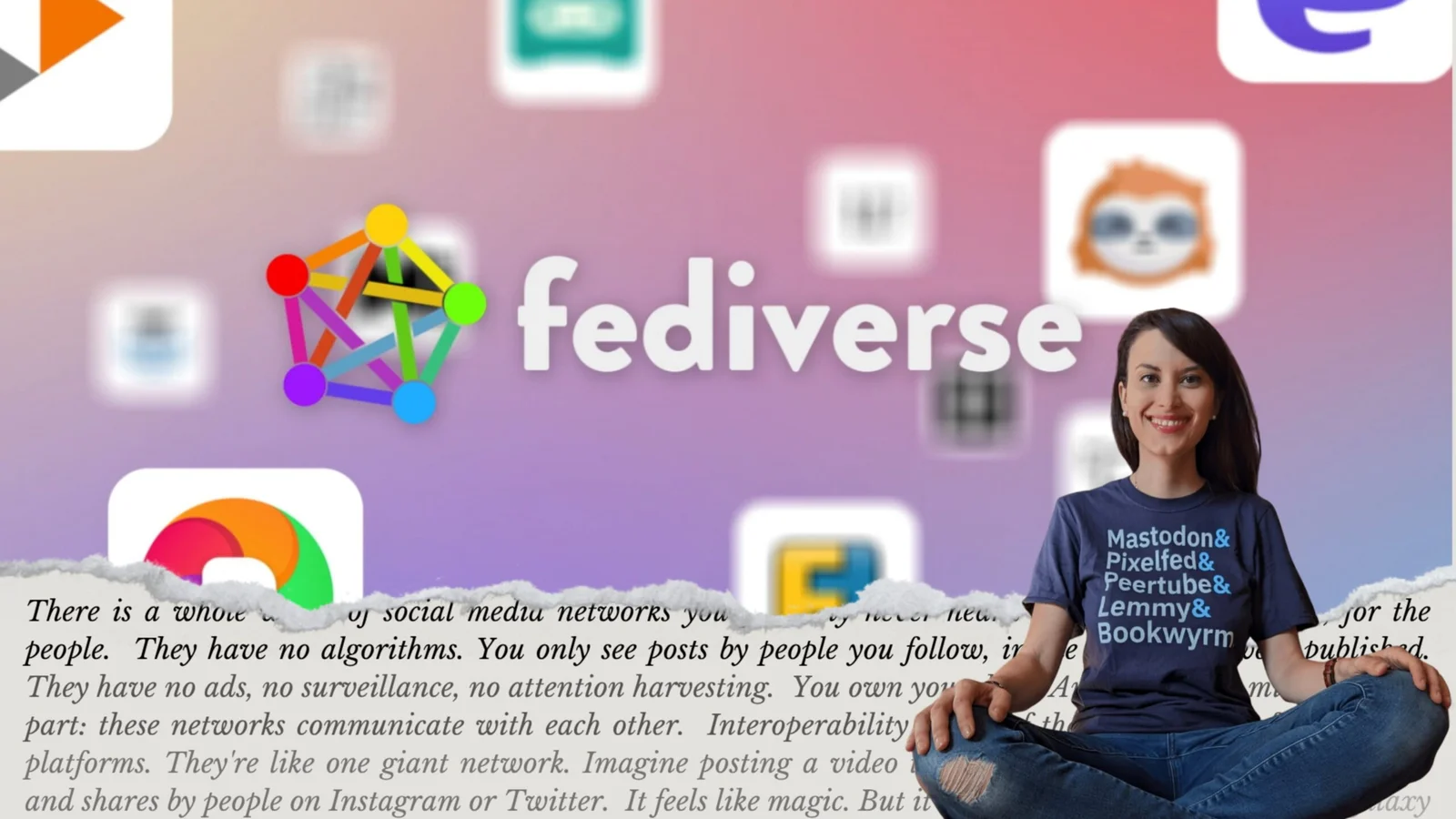
And here is a link to one of the best portals to the Fediverse. It explains everything in plain English and many other languages.

Who uses the Fediverse?
I would say that there are three main groups of users:
- The original group is mostly made up of people who work in IT as a job or a hobby. They are developers and tinkerers. They're not the type to join the Tech Bro crowd; quite the opposite, in fact. They're the ones who would still build a computer in their garage just to see if they could. They remember – or, for the younger ones, have heard about – the internet from before social media, in the 1990s, when it was free and open, and when everyone could have their own little space online to express themselves, when we thought the internet would usher in a new Enlightenment. This internet seemingly died in the second half of the 2000s. Except it didn't die. The FOSS (free and open-source software) crowd kept it alive, and the Fediverse is their offspring and a chance for a free and open internet to return.
- The second group consists of various oppressed minorities, particularly from the LGBT+ community, who have found a safe online space in the Fediverse, far from the harassment and violence they often experienced on mainstream social media.
These two groups may seem like an odd combination at first, but that would overlook the fact that many FOSS activists are LGBT+.
Another minority that is very common on the Fediverse are neurodivergent people. Maybe because a lot of them belong to the two groups I just mentioned? Not sure. - The third group includes a diverse mix of people who mostly have one thing in common: they stopped using Twitter when Elon Musk bought it. They couldn't condone staying in a place where xenophobia, racism, intolerance, and fascism are normalized. These people found a new online home on the Fediverse for various reasons, primarily because the Fediverse inherently opposes those things.
In a few lines, my personal history with the Fediverse is as follows: I created my first Mastodon account shortly after the platform launched in 2017. At that time, I was very curious about social media and I tried all the platforms I heard about. Back then, though, the main social media platforms were still usable, and while I liked the concept very much but didn't feel the need to be active on Mastodon, especially since almost none of my friends were on it and the conversations were quite IT-oriented. Still, I always kept it in the back of my mind. I started using it again irregularly in spring 2022, when Musk's purchase of Twitter was made official. I completely jumped ship by the end of 2022. I've used it almost daily ever since; it's now my main social media platform. I haven't used Twitter since winter 2023 and eventually closed all my accounts there.
In summation
In short, we have not just one social media platform, but a set of platforms that belong to the people and that no billionaire can buy or control. All of these platforms are interoperable. The vast majority of its users are decent and respectful people trying to make the internet and society a better place.
Could this be the perfect social media?
Almost... with a few caveats unfortunately.
New users usually encounter two problems, so let's address them right away. There's no need to pretend they don't exist.
Two negative things you often hear about the Fediverse from nonusers are that it's too difficult to use and that the people there are unwelcoming to newcomers.
Let me reassure you: this is not true. However, these two preconceived ideas stem from real, albeit minor in my opinion, issues.
Is the Fediverse difficult to use?
One aspect of the Fediverse in particular has deterred many potential users, causing them to either abandon the platform shortly after their arrival or never start using it. I will not lie to you, there is a learning curve, and it can be steep if you're not computer-savvy.
Many people say it's too difficult to use, but I reject that statement. It's true that it's a tool that needs to be learned. However, it's not difficult if you simply read the "instructions" (there are no official instructions, but an online search will bring up various tutorials if needed), use your brain, and try things out. The problem is that all the other social media owned by "Big Tech" are very easy to start using. You don't even need to think. That's part of their appeal. This is also the beginning of a long list of reasons why they are dangerous. From the very beginning, they train us not to think too much about what we're doing and to remain unaware of how they work. This makes it easier for them to manipulate us later on with their addictive and toxic algorithms.
The Fediverse forces you to think. It makes you think about how it works and what you're using it for. It forces you to be intentional.
It's a shame that this small, positive hurdle discourages so many people. All in all, though, I consider it a good thing. My whole point is to be more intentional and in control of the technology we use, to understand it better, not from a technical point of view, but from mostly a societal one. This is the very reason why I started this Neo-Luddite Handbook.
Are people unwelcoming on the Fediverse?
No, the vast majority is very welcoming as long as you follow basic netiquette (Wow, I think I hadn't used that term in over ten years!) There may be some unwritten rules on the Fediverse, but the only one I can think of is that you're not there for clout; you're there to have real conversations with real people (they can be serious or not). You don't broadcast; you communicate. Influencers don't like the Fediverse because it doesn't work well for them; becoming viral isn't really a thing there. I see this as a good thing.
However, it's true that there are certain "gatekeepers" (sometimes nicknamed the "Home Owner Association," they hate that) who don't want new people to join. They want the Fediverse to remain almost confidential.
While some are immature about it (they see it as their "cool space" and don't want it to become mainstream because mainstream is not cool), others have legitimate reasons. Those who have found a safe space in the Fediverse may be afraid that this safety will be threatened by many newcomers from more mainstream backgrounds. Some users who have been there since the beginning dislike how "normies" influence and change the Fediverse with their arrival. These long-time users are afraid that, the same causes leading to the same effects, if the Fediverse had hundreds of millions of users, it would become as toxic and terrible as mainstream social media. These are valid concerns, but the methods used by the "gatekeepers" are not always acceptable.
A even smaller minority of "gatekeepers" doesn't want the Fediverse to be open to everyone. Do you know the Fediverse's nickname? The Open Web (that's also the 'O' in "FOSS"). My opinion of these people in particular is that maybe the Fediverse isn't for them, and they made a mistake calling this place home.
In any case, just keep in mind that the Fediverse has no centralized leadership. The developers of the platforms (Mastodon, Peertube, Pixelfed, etc.) decide how they're developed. However, they're often collective projects, and the developers tend to listen to user feedback. The administrators of each instance (server) decide the rules for their instance. The only rules you need to follow are the rules of your instance/server. If a gatekeeper disapproves of your actions, identity, or anything else, the best approach is to simply ignore them. Don't hesitate to use the "mute" and "block" functions if necessary.
But I don't want to scare you. Yes, there is a learning curve to using the Fediverse, but it's worth it. Gatekeepers nowadays are much quieter than in the past, so there's a good chance they won't bother you when you join. I just wanted to tell you about them in case you heard that it's not a welcoming place.
How to get started with the Fediverse?
There are a few guides online. Some are useful and well-written; others are not. The site I linked above is a good one.
Otherwise, here is my mini-guide to getting started with the Fediverse.
- Start with either Mastodon or Pixelfed. They're the biggest platforms, but more importantly, they're the easiest to start with and learn how to navigate the Fediverse. Once you're more familiar with how everything works, you can create accounts on other platforms if you feel like it. As a reminder, Mastodon is a microblogging platform similar to Twitter, and Pixelfed is a photo-sharing platform similar to Instagram.
- Choose a server. To be honest, this is usually the scariest part because it feels like you're drowning in choices. The most important thing is to not overthink it. With both platforms, you can migrate to another server if needed in the future. Both Mastodon and Pixelfed have websites that offer lists of servers you can join (see below). Use the filters, read the descriptions, the server rules, and join one that fits you. For Mastodon, my advice is to not join Mastodon.Social because it has become too big. That could be a hurdle for the next steps, especially the "finding people to follow" part. The best option is to find a "local" server if there is one (for example, mastodon.au if you're Australian or mstdn.ca if you're Canadian – Just make sure to read the descriptions and rules before signing up) and/or to join a medium-sized server (with a few hundred to a few thousand monthly users). For Pixelfed, there are fewer servers, so it's easier to choose and not as important. Here are two links to get started:
- After choosing your server, create and complete your profile. If you want followers, don't put off that step for later. In the Fediverse, people usually look at others' profiles before deciding whether to follow them back. Once again, don't overthink it; everything can be edited and refined later, with one exception: your username! It can't be changed without switching servers.
- Get familiarized with the settings. I'm always baffled by how many people use platforms and apps without ever venturing into the settings section. It's a crucial part of every platform and app because it tells you what it can and can't do. This is where you decide many of the things you will or won't do with it. Never ignore the settings, quite the contrary, and this is not specific to the Fediverse.
- Talking about apps. If you want to use the Fediverse on your mobile device, know that there are many apps you can use for this purpose. Don't worry too much about it now; just use the main, official app. You can (and should) explore other apps later.
- Build your timeline! This is another important step.
I recently noticed that some people, especially younger ones, sometimes get stuck at this point. I was often surprised by this until I realized that they had only used platforms with heavy algorithms that decide what you see, regardless of who you follow. When they arrive on the Fediverse, they're encounter a blank timeline and are greatly confused.
Unlike most social media platforms, those on the Fediverse don't have algorithms. Rather, they only have one: the reverse chronological order of posts from the accounts you follow. It's just like the old days of Twitter and Facebook. This is not a bug; it's a feature, one of the most important ones. You decide what's on your timeline and no one else does.
So, how do you get started? This is when your choice of server matters at least a little, especially in terms of its number of active users (hence the above advice when deciding on your server). Your server has a certain number of "live feeds" that show posts from people on that server or from people followed by those on your server. The second option will give you a somewhat random feed, while the first option could be more focused, depending on the server. From there, you will hopefully find people you think are interesting. Just follow them.
The more efficient method, in my opinion, is to search for keywords and hashtags related to your interests.
On both Mastodon and Pixelfed, you can follow hashtags!!! It's an amazing tool for finding posts about your interests and the people who write them. Of course, the corollary is that you should use hashtags yourself when posting. I know they're used less and less on algorithm-driven platforms, but they're still very important in the Fediverse.
How do you follow on the Fediverse?
It's not always obvious. If you find someone on your server whom you want to follow, it's self-explanatory. You click the "Follow" button on their profile.
If the person is not on the same server as you, however, it can be tricky. I don't want to overwhelm you with too many details and use cases, but if you're looking at a profile and something "strange" happens when you try to follow them, it's better to try the other method. Personally, I pretty much only use the other method to avoid unpleasant surprises.
The other method is very easy, though perhaps not intuitive at first (the infamous learning curve). Let's use my Mastodon account as an example. Its URL is https://setouchi.social/@David. Clicking on it will take you to my profile page on my server. You won't be able to follow me just by clicking the "Follow" button. Instead, you will be prompted to sign in with your own account. Just follow the instructions, and it should work. However, there is an easier and faster way. All Fediverse accounts have a unique handle. Mine is this: @David@setouchi.social. You can also see it on my profile linked above. The first part between the two @s is the username. The second part is the server.
The easiest way to follow an account is to copy the handle and paste it into the search bar of your account. If all goes well, the process will be seamless; the profile page should appear, you should be able to follow it.
Sometimes, though, it doesn't work. It's not exactly a bug, but I don't want to overwhelm you with details and technicalities.
Make sure you become familiar with this method, because it's also the one you need to use if you want to follow hashtags (and, once again, you should) and... if you want to follow websites!
I haven't mentioned it yet, but some websites are also part of the Fediverse. That thing goes far beyond basic social media! Various platforms (including some but not all WordPress sites) can connect to the Fediverse.
Do you know what else connects to the Fediverse? Ghost blogs and newsletters! In fact, this very blog/newsletter you're reading now has a Fediverse account. Here's its handle: @david@davidbilla.net. (Disclaimer: It may change in the future, so if you're reading this weeks or months after I wrote it, it may have changed, and I may have forgotten to update this post.) If you follow it, posts from davidbilla.net will appear directly in your Fediverse timeline. Ghost sites also have a microblogging function similar to Mastodon's, but since it's less developed, I don't use it as much. I'd love for my microblogging and regular blogging accounts to be one and the same, but not just yet. - You're all set!
As you follow more people and hashtags, your timeline will gradually fill with posts.
I know that was a little long, but I warned you: there is a learning curve (I didn't even explain everything). Just take your time, go slowly, learn the ropes, and all should go well.
Pros and Cons of the Fediverse
These days, I'd say the Fediverse is my favorite part of the social internet. It's where I spend most of my time online, aside from writing blog posts.
Of course, it's not perfect; it has its pros and cons.
I'm going to try to list them below. Note that this list is personal, and others may have different ideas about what constitutes a pro or a con.
Fediverse Pros:
- The people. Yes, I like the idea of the Fediverse because of its decentralized, federated architecture. Those two keywords are ubiquitous there. But the main reason I love the place is its users. They are very diverse, and the place is far from an echo chamber. And they're mostly people who talk about what they like and care about.
I think they're definitely my favorite part of the Fediverse. While many people still confuse "constantly posting and sharing outrage on social media" with "militancy," I feel that there are fewer and fewer of them in the Fediverse. Most active users, at least in my circles, are people who have consciously or not decided to have a positive approach. They talk about things they like, they do and care about. They don't post about things they hate or find offensive. Over time, there are even some "communities" forming. That's also a big difference from centralized social media. Don't hope to go viral and reach the entire Fediverse; you won't. Instead, hope to spread to and reach people who care about what you have to say. If you're active enough, you probably will, and you will have meaningful relationships with them. - It's not US-centric. In this day and age, when the US is no longer a reliable country and the rest of the world is finally realizing how much it depended on the US for all things internet-related, Mastodon is a breath of fresh air. Mastodon is originally German, and Pixelfed is Canadian. The majority of long-time users are European. Nowadays, you'll find people from many corners of the planet, though unfortunately, most are from "Western countries" and Americans are not the majority. You will encounter people from many different countries, none of which are more prominent than the others.
- You are in charge of the kind of content you see, not an algorithm designed to maximize engagement. I've already discussed how to follow people and hashtags, to craft your timeline, but there's more to it than that. Filters are also very important. Most people online like to talk about many different things (including me, as you may have noticed). You may care about some topics that a person you follow talks about, but not others. Fortunately, you can simply mute certain keywords or hashtags, and those posts won't appear in your timeline. Maybe you love what a person writes, but find what they repost or boost uninteresting. No problem! You can just mute their boosts only. And so on. Once again, explore all the settings and don't be afraid to click around (the tiny menus on people's profiles, your notifications tab, etc.).
- Decentralization. Additionally, a positive consequence is that you're not being tracked, spied on, or manipulated by the "owners" as there aren't any.
Users are taking back control of the internet. If you're old enough to remember the internet from the end of the 20th century, before companies realized they could make money from it and eventually ruined it, many things will feel familiar. - Federation and interoperability: While you can have multiple accounts, it is not required, and you can follow one platform from another.
There are also a few cons:
Fediverse Cons:
- The learning curve can be more or less steep depending on how technically inclined you are. Many people are making a lot of effort to make the Fediverse more beginner-friendly (for example, the video and link I posted above). However, more can be done. As I mentioned, however, the learning curve is not all negative. It forces you to reflect on what you're doing and what you want to do.
- Most of the Fediverse is developed, created, and implemented by volunteers with little to no budget because it's a passion project for them. As a result, things are not as polished as platforms created with millions of dollars. Unfortunately, this is a deal-breaker for some people.
Also, maintaining a server can also be stressful, time-consuming, and costly. Sometimes, some administrators consider that this is more than they can deal with and servers cease to be maintained and close. So it's important to be aware of what's happening on your server (and to get to know your admin, or at least to follow them) as well as to have a backup plan, such as a secondary account on another server, just in case. - This could be considered a con, but it's not necessarily one. If you want to use different platforms, you will need a separate account for each one. The same goes for trying another server on the same platform. You may end up with too many accounts if you like testing new things. However, keep in mind that you often can merge accounts to clean things up.
I may update the lists as more examples come to mind.
Alright, this post is already way too long, but I think it gives a clear idea of what the Fediverse is.
If you have any question, do not hesitate to ask me.
And yes, I know, at the beginning of the post I mentioned that there were two things I wanted to talk about. Well, how about we keep the second thing for another day, or I'll beat every record for the longest post.
So, stay tune for part two sooner or later (I promise it'll be shorter)

As always, if you enjoyed this post, please share it with your friends and contacts on your preferred platforms. It would mean the world to me, as would your subscription to the newsletter (it's free, although you can also help me pay the bills if you can afford it).
In this day and age, when you can no longer rely on search engines to be discovered, and when the web is becoming increasingly full of AI slop, it's more important than ever to know that you are read and followed by real humans. This is what still motivates me to write online.
Until next time.
Best,
David



Comments ()