
A few things about the circumflex accent in French
This post is from my old "Ask a Frenchman" series, which I'm reviving a little. Today, we're talking about the French and English languages, and diacritics.
Today, we’re delving into one of the oddities of the French language: its diacritics, more specifically, the circumflex accent.
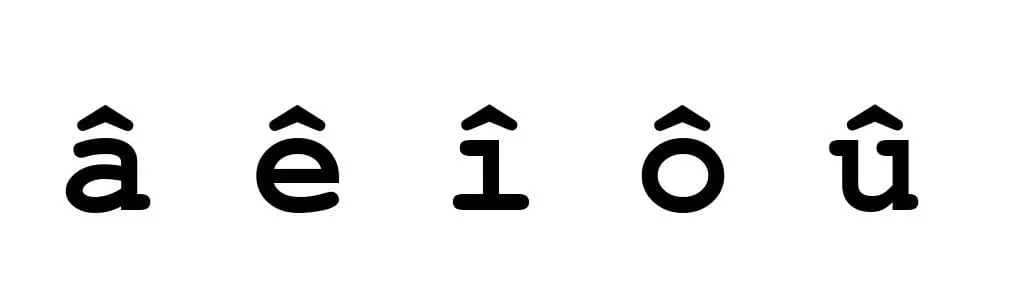
If you’re not too familiar with the language, the circumflex accent is the little "roof" (my first-grade teacher, Ms. Rieumajou, called it "a little hat") that can be found above certain vowels. Like this: â, ê, î, ô, û.
It all started with a question I was asked a while ago.
“Why is there a circumflex accent on dîner? I know that, in most cases, it replaces a missing ‘s,’ but what’s the story with this word?”
Here is my answer, along with a few more details about this funny-looking accent. And yes, I'm totally using this question as an excuse to tell you about that part of the history of the French language. I'd use anything as an excuse to talk about the history of the French language!
First of all, the person who asked the question is right. The circumflex accent replaces an 's' that was present in Old French and that is usually still present in English, as seen in words like forêt and forest, or hôpital and hospital.
So, what about dîner? One doesn't say "to disne" or "disner" in English!
Well, the circumflex accent in "dîner" does indeed replace a missing 's,' but it lost that letter a very long time ago.
All of these words that lost their "s" in French but not in English lost it quite recently, mostly in the late Middle Ages, long after William the Conqueror brought the French language (along with the all the 's') to England in 1066.
A quick reminder for those whose knowledge of history and linguistics may be lacking: Although English is considered a Germanic language, mostly because of its origins, syntax and more, a significant part of its vocabulary actually comes from French. The reason is that the Norman who conquered England in the eleventh century were French speakers. Their descendants became England's dominant class (i.e., the aristocracy), and they remained French speakers for a few centuries, long enough to have a substantial influence on the English language. What we call "English" today is completely different from the language called "English" in the tenth century. Modern English is truly a mix of Old English and French (among other things, but they're not our topic today).
You may be perplexed that, two paragraphs ago, I meant "a few hundred years ago" when I said "quite recently." Yes, "a few hundred years" when dealing with the evolution of languages is usually "quite recently." (Not always, but usually.)
So, dîner in French comes from the Latin verb disjejunare, meaning "to stop fasting." The prefix dis- meaning "to stop" is not uncommon in English. We find it in many words, actually most of the words starting with dis-.
You'll also notice that the French verb déjeuner ("to have lunch") comes from the same Latin verb and is almost a literal translation of "to stop fasting." The French prefix dé- is equivalent to the English dis- and jeuner means "to fast."
In the case of disjenunare eventually becoming dîner in French and both dine and dinner in English, the 's' disappeared quite early in the French language. I’m not sure exactly when, but it was most certainly before the Norman invasion because while have a circumflex accent in French, you don't say "to disne" in English.
The circumflex accent is a relatively recent addition to the French language. It didn't instantly replace the 's' that had disappeared; rather, it emerged in the 16th century when the French spelling system started being formalized. Then, it was more of a homage to the long-gone 's' than anything else.
I think this answers the question, doesn't it?
If you found this post interesting do not hesitate to share with with your contacts.
Also, if you haven't done so yet, please consider subscribing to the newsletter, it's free if you want it to be.
Thanks for reading.
Until next time.
Best,
David

Comments ()